
Clay Balls . . .

IMG_3339

Clay Balls
Author Unknown

A man was exploring caves by the seashore. In one of the caves he found a canvas bag with a bunch of hardened clay balls. It was like someone had rolled clay balls and left them out in the sun to bake. They didn’t look like much, but they intrigued the man so he took the bag out of the cave with him.

As he strolled along the beach, he would throw the clay balls one at a time out into the ocean as far as he could. He thought little about it until he dropped one of the balls and it cracked open on a rock. Inside was a beautiful, precious stone.

Excited the man started breaking open the remaining clay balls. Each contained a similar treasure.

He found thousands of dollars worth of jewels in the 20 or so clay balls he had left. Then it struck him. He had been on the beach a long time. He had thrown maybe 50 or 60 of the clay balls with their hidden treasure into the ocean waves. Instead of thousands of dollars in treasure, he could have taken home tens of thousands, but he just threw it away.

It’s like that with people. We look at someone, maybe even ourselves, and we see the external clay vessel. It doesn’t look like much from the outside. It isn’t always beautiful or sparkling so we discount it. We see that person as less important than someone more beautiful or stylish or well known or wealthy. But we have not taken the time to find the treasure hidden inside that person by God.

There is a treasure in each and every one of us. If we take the time to get to know that person, and if we ask God to show us that person the way He sees them, then the clay begins to peel away and the brilliant gem begins to shine forth.

May we not come to the end of our lives and find out that we have thrown away a fortune in friendships because the gems were hidden in bits of clay.

May we see the people in our world as God sees them.

Consider this: Change how you look at another person today. There is a treasure inside.
The Royal Servant . . .

IMG_3339

Wisdom Story: “Royal Servant”

The King of Kamera in Africa was a proud and stern man, feared by all his subjects.

One day while sitting in his mud palace, surrounded by fawning courtiers and watched by a multitude of people who had come to see him, he was suddenly overcome by a sense of grandeur and loudly declared that he was master of the world and that all men were his servants.

“You are mistaken,” said a frail voice. “All men are servants of one another.”

A deathly silence followed the remark. The blood froze in the veins of the people assembled there. Then the king exploded in anger.

“Who said that!” he demanded, rising from the royal stool. “Who dares suggest that I am a servant!!”

“I do,” said a voice in the crowd, and the people parted to reveal a white-haired old man, leaning heavily on a stout stick.

“Who are you?” asked the king.

“I am Boubakar,” said the man. “We have no water in our village. I have come to ask for a well to be dug there.”

“So you are a beggar!” roared the king, striding down to where the man stood. “Yet you have the temerity to call me a servant!”

“We all serve one another,” said Boubakar, showing no fear, “and I will prove it to you before nightfall.”

“Do that,” said the monarch. “Force me to wait on you. If you can do that I will have not one but three wells dug in your village. But if you fail, you’ll lose your head!”

“In our village,” said the old man, “when we accept a challenge, we touch the person’s feet. Let me touch your feet. Hold my stick.”

The king took the stick and the old man bent down and touched the monarch’s feet.

“Now you may give it back to me,” he said, straightening up. The king gave him back his stick.

“Do you want any more proof?” asked Boubakar.

“Proof?” asked the king, bewildered.

“You held my stick when I asked you to and gave it back to me when I asked you for it,” said the old man. “As I said, all good men are servants of one another.”

The king was so pleased with the Royal Servant Boubakar’s wit and daring that he not only had wells dug in his village but also retained him as an adviser.”

Consider this: We all serve each other.

I Am There . . .

IMG_3339

I Am There
James Dillet Freeman

Do you need Me?
I am there.
You cannot see Me, yet I am the light you see by.
You cannot hear Me, yet I speak through your voice.
You cannot feel Me, yet I am the power at work in your hands.

I am at work, though you do not understand My ways.
I am at work, though you do not understand My works.
I am not strange visions. I am not mysteries.

Only in absolute stillness, beyond self, can you know Me
as I AM, and then but as a feeling and a faith.

Yet I am here. Yet I hear. Yet I answer.
When you need ME, I am there.
Even if you deny Me, I am there.
Even when you feel most alone, I am there.
Even in your fears, I am there.
Even in your pain, I am there.

I am there when you pray and when you do not pray.
I am in you, and you are in Me.
Only in your mind can you feel separate from Me, for
only in your mind are the mists of “yours” and “mine”.
Yet only with your mind can you know Me and experience Me.

Empty your heart of empty fears.
When you get yourself out of the way, I am there.
You can of yourself do nothing, but I can do all.
And I AM in all.

Though you may not see the good, good is there, for
I am there. I am there because I have to be, because I AM.

Only in Me does the world have meaning; only out of Me does the world take form; only because of ME does the world go forward.
I am the law on which the movement of the stars
and the growth of living cells are founded.

I am the love that is the law’s fulfilling. I am assurance.
I am peace. I am oneness. I am the law that you can live by.
I am the love that you can cling to. I am your assurance.
I am your peace. I am ONE with you. I am.

Though you fail to find ME, I do not fail you.
Though your faith in Me is unsure, My faith in you never
wavers, because I know you, because I love you.

Beloved, I am there.

Consider this: You are never alone.

A Violin With Three Strings …

IMG_3339

A Violin With Three Strings
Jack Riemer

On Nov. 18, 1995, Itzhak Perlman, the violinist, came on stage to give a concert at Avery Fisher Hall at Lincoln Center in New York City.

If you have ever been to a Perlman concert, you know that getting on stage is no small achievement for him. He was stricken with polio as a child, and so he has braces on both legs and walks with the aid of two crutches. To see him walk across the stage one step at a time, painfully and slowly, is an awesome sight.

He walks painfully, yet majestically, until he reaches his chair. Then he sits down, slowly, puts his crutches on the floor, undoes the clasps on his legs, tucks one foot back and extends the other foot forward. Then he bends down and picks up the violin, puts it under his chin, nods to the conductor and proceeds to play.

By now, the audience is used to this ritual. They sit quietly while he makes his way across the stage to his chair. They
remain reverently silent while he undoes the clasps on his legs. They wait until he is ready to play.

But this time, something went wrong. Just as he finished the first few bars, one of the strings on his violin broke. You
could hear it snap – it went off like gunfire across the room. There was no mistaking what that sound meant. There was no mistaking what he had to do.

We figured that he would have to get up, put on the clasps again, pick up the crutches and limp his way off stage – to either find another violin or else find another string for this one. But he didn’t. Instead, he waited a moment, closed his eyes and then signaled the conductor to begin again.

The orchestra began, and he played from where he had left off. And he played with such passion and such power and such purity as they had never heard before.

Of course, anyone knows that it is impossible to play a symphonic work with just three strings. I know that, and you know that, but that night Itzhak Perlman refused to
know that.

You could see him modulating, changing, re-composing the piece in his head. At one point, it sounded like he was de-tuning the strings to get new sounds from them that they had never made before.

When he finished, there was an awesome silence in the room. And then people rose and cheered. There was an extraordinary outburst of applause from every corner of the auditorium. We were all on our feet, screaming and cheering, doing everything we could to show how much we appreciated what he had done.

He smiled, wiped the sweat from this brow, raised his bow to quiet us, and then he said – not boastfully, but in a quiet, pensive, reverent tone – “You know, sometimes it is the artist’s task to find out how much music you can still make with what you have left.”

What a powerful line that is. It has stayed in my mind ever since I heard it. And who knows? Perhaps that is the definition of life – not just for artists but for all of us.

Here is a man who has prepared all his life to make music on a violin of four strings, who, all of a sudden, in the middle of a concert, finds himself with only three strings; so he makes music with three strings, and the music he made that night with just three strings was more beautiful, more sacred, more memorable, than any that he had ever made before, when he had four strings.

So, perhaps our task in this shaky, fast-changing, bewildering world in which we live is to make music, at first with all that we have, and then, when that is no longer possible, to make music with what we have left.

Consider this: Make some music today!

Perpectives . . .

IMG_3339

Perspectives
Author Unknown

One day a father and his rich family took his young son on a trip to the country with the firm purpose to show him how poor people can be. They spent a day and a night in the farm of a very poor family. When they got back from their trip the father asked his son, “How was the trip?”

Very good, Dad!”

“Did you see how poor people can be?” the father asked.

“Yeah!”

“And what did you learn?”

The son answered, “I saw that we have a dog at home, and they have four. We have a pool that reaches to the middle of the garden, they have a creek that has no end. We have imported lamps in the garden, they have the stars. Our patio reaches to the front yard, they have a whole horizon.”

When the little boy was finishing, his father was speechless.

His son added, “Thanks, Dad, for showing me how poor we are!”

Isn’t it true that it all depends on the way you look at things? If you have love, friends, family, health, good humor and a positive attitude toward life, you’ve got everything!

You can’t buy any of these things. You can have all the material possessions you can imagine, provisions for the future, etc., but if you are poor of spirit, you have nothing!

Consider this: What’s your perspective today?

Reading More and Dusting Less . . .

IMG_3339

Reading More and Dusting Less
Ann Wells

I’m reading more and dusting less. I’m sitting in the yard and admiring the view without fussing about the weeds in the garden. I’m spending more time with my family and friends and less time working. Whenever possible, life should be a pattern of experiences to savor, not to endure. I’m trying to recognize these moments now and cherish them.

I’m not ‘saving’ anything; we use our good china and crystal for every special event such as losing a pound, getting the sink unstopped, or the first Amaryllis blossom. I wear my good blazer to the market. My theory is if I look prosperous, I can shell out $28.49 for one small bag of groceries. I’m not saving my good perfume for special parties, but wearing it for clerks in the hardware store and tellers at the bank. ‘Someday’ and ‘one of these days’ are losing their grip on my vocabulary. If it’s worth seeing or hearing or doing, I want to see and hear and do it now.

I’m not sure what others would’ve done had they known they wouldn’t be here for the tomorrow that we all take for granted. I think they would have called family members and a few close friends. They might have called a few former friends to apologize and mend fences for past squabbles. I like to think they would have gone out for a Chinese dinner or for whatever their favorite food was. I’m guessing; I’ll never know.

It’s those little things left undone that would make me angry if I knew my hours were limited. Angry because I hadn’t written certain letters that I intended to write one of these days. Angry and sorry that I didn’t tell my husband and parents often enough how much I truly love them. I’m trying very hard not to put off, hold back, or save anything that would add laughter and luster to our lives.

And every morning when I open my eyes, I tell myself that it is special. Every day, every minute, every breath truly is a gift from God.

Consider this: Today is a gift, unwrap it.

One Thousand Marbles . . .


marbles

One Thousand Marbles
Jeffrey Davis

I’m a Ham radio operator and spend some time working with radios and electronics. So when I heard this story it really made me think! I hope that you will find some application in your own life as well…

A few weeks ago, I was shuffling toward the basement shack with a steaming cup of coffee in one hand and the morning paper in the other. What began as a typical Saturday morning, turned into one of those lessons that life seems to hand you from time to time. Let me tell you about it.

I turned the dial up into the phone portion of the band on my ham radio in order to listen to a Saturday morning swap net. Along the way, I came across an older sounding chap, with a tremendous signal and a golden voice. You know, the kind, he sounded like he should be in the broadcasting business. He was telling whomever he was talking with something about “a thousand marbles”.

I was intrigued and stopped to listen to what he had to say. “Well, Tom, it sure sounds like you’re busy with your job. I’m sure they pay you well but it’s a shame you have to be away from home and your family so much. Hard to believe a young fellow should have to work sixty or seventy hours a week to make ends meet. Too bad you missed your daughter’s dance recital.”

He continued, “Let me tell you something, Tom, something that has helped me keep a good perspective on my own priorities.” And that’s when he began to explain his theory of “a thousand marbles.”

“You see, I sat down one day and did a little arithmetic. The average person lives about seventy-five years. I know, some live more and some live less, but on average, folks live about seventy-five years.”

“Now then, I multiplied 75 times 52 and I came up with 3,900, which is the number of Saturdays that the average person has in their entire lifetime. Now stick with me Tom, I’m getting to the important part.”

“It took me until I was fifty-five years old to think about all this in any detail,” he went on, “and by that time I had lived through over twenty-eight hundred Saturdays. I got to thinking that if I lived to be seventy-five, I only had about a thousand of them left to enjoy.”

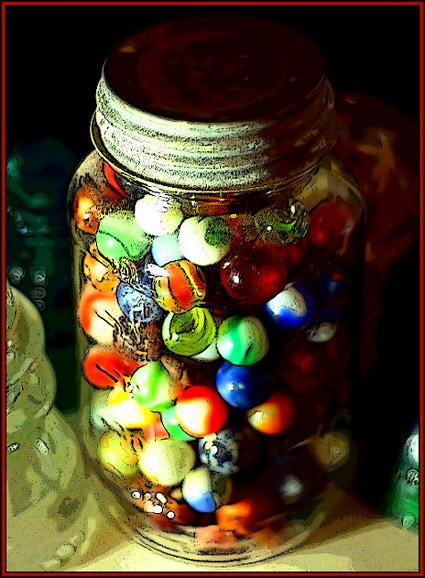
“So I went to a toy store and bought every single marble they had. I ended up having to visit three toy stores to round-up 1,000 marbles. I took them home and put them inside of a large, clear plastic container right here in the shack next to my gear. Every Saturday since then, I have taken one marble out and thrown it away.”

“I found that by watching the marbles diminish, I focused more on the really important things in life. There is nothing like watching your time here on this earth run out to help get your priorities straight.”

“Now let me tell you one last thing before I sign-off with you and take my lovely wife out for breakfast. This morning, I took the very last marble out of the container. I figure if I make it until next Saturday then I have been given a little extra time. And the one thing we can all use is a little more time.”

“It was nice to meet you Tom, I hope you spend more time with your family, and I hope to meet you again.”

You could have heard a pin drop on the radio when this fellow signed off. I guess he gave us all a lot to think about. I had planned to work on the antenna that morning, and then I was going to meet up with a few hams to work on the next club newsletter. Instead, I went upstairs and woke my wife up with a kiss.

“C’mon honey, I’m taking you and the kids to breakfast.”

“What brought this on?” she asked with a smile.

“Oh, nothing special, it’s just been a long time since we spent a Saturday together with the kids. Hey, can we stop at a toy store while we’re out? I need to buy some marbles.”

Consider this: How many marbles are in your container?

Every Day Counts . . .

IMG_3339

Many people who’ve read my latest book Meaningful: The story of ideas that fly say that the introduction impacted them the most. It would never have been written without a nudge from a trusted friend, who reminded me after he’d read the manuscript that some people might only read one page. We don’t always have the luxury of getting people to pay attention to everything we want them to remember. He told me to write the page people needed to read. This is what I wrote.

– Bernadette Jiwa

EVERY DAY COUNTS

Our deepest fear is that we will run out of places to hide—that one day there will be no boss who allows us to remain invisible and no political or economic circumstance that stops us from doing the most important work of our lives. We are the ultimate paradox. There are only two things we want—we want to hide and we want to be seen.

I know you’re scared that your idea might not work.
I know you worry about being wrong, far more than you celebrate the things you get right.
I know you waste time being anxious that you won’t measure up to someone else’s metric of success.
I know that some days you say one thing and do another.
Why else would the same New Year’s resolutions happen every new year?
I know you are afraid people will laugh at you.
I know that every day you walk a tightrope between getting over these fears and creating an impact.
I know you’re ‘this close’ to a breakthrough.
I wrestle with these fears, too. Every single day. On my best days, I put away my nervous laughter, the twenty emails I must answer and my to-do list, and I do the things I don’t have the courage to do on the days I want to hide. The things that matter—the kind of things I wish my brother had had a chance to do.

My brother never posted a photo on Facebook or created an iTunes playlist. He didn’t ever book a room on Airbnb or make a call from an iPhone. He never got to know what an app was and how magical the Internet would be. He will never walk across the Brooklyn Bridge or eat a moon pie in Gramercy Park. And he won’t be there to kiss his daughter when she turns eighteen in ten days’ time.

Johnny was the kid who wouldn’t come in from playing outside until the very last warning. He lit up any room just by walking into it. Like the Pied Piper, he had trails of friends who followed him and women who adored him (yes, he was impossibly good-looking, too). He was funny and magnetic and caring and genuine, and he died right on the cusp of a brand-new millennium, with a lot of dreams left inside him because he didn’t understand that there was no reason to wait for tomorrow to be better—that he didn’t need to hide. He was the most magnificent person who had everything he needed, and he didn’t know it.
Every day counts.

The two most important things we can do are to allow ourselves to be seen AND to really see others. The greatest gift you can give a person is to see who she is and to reflect that back to her. When we help people to be who they want to be, to take back some of the permission they deny themselves, we are doing our best, most meaningful work.
I see you

What’s the one thing your audience needs to hear? Go tell them.

Consider this: What one page do you need to write?

Two Days We Should Not Worry . . .

IMG_3339

Two Days We Should Not Worry
Author Unknown

There are two days in every week about which we should not worry, two days which should be kept free from fear and apprehension.

One of these days is Yesterday with all its mistakes and cares,
its faults and blunders, its aches and pains.

Yesterday has passed forever beyond our control.
All the money in the world cannot bring back Yesterday.

We cannot undo a single act we performed;
we cannot erase a single word we said.
Yesterday is gone forever.

The other day we should not worry about is Tomorrow
with all its possible adversities, its burdens,
its large promise and its poor performance;
Tomorrow is also beyond our immediate control.

Tomorrow’s sun will rise,
either in splendor or behind a mask of clouds, but it will rise.
Until it does, we have no stake in Tomorrow,
for it is yet to be born.

This leaves only one day, Today.
Any person can fight the battle of just one day.
It is when you and I add the burdens of those two awful eternities Yesterday and Tomorrow that we break down.

It is not the experience of Today that drives a person mad,
it is the remorse or bitterness of something which happened Yesterday and the dread of what Tomorrow may bring.

Let us, therefore, Live but one day at a time.

Consider this: Live in the moment. Seize the day.

I Worried . . .

IMG_3339

I Worried

– Mary Oliver

I worried a lot. Will the garden grow, will the rivers
flow in the right direction, will the earth turn
as it was taught, and if not how shall
I correct it?

Was I right, was I wrong, will I be forgiven,
can I do better?

Will I ever be able to sing, even the sparrows
can do it and I am, well,
hopeless.

Is my eyesight fading or am I just imagining it,
am I going to get rheumatism,
lockjaw, dementia?

Finally I saw that worrying had come to nothing.
And gave it up. And took my old body
and went out into the morning,
and sang.

Consider this: Don’t worry.